Mutation Register (MR) in Karnataka (ಮ್ಯುಟೇಶನ್ ದಾಖಲೆ)
Complete Ownership Change History
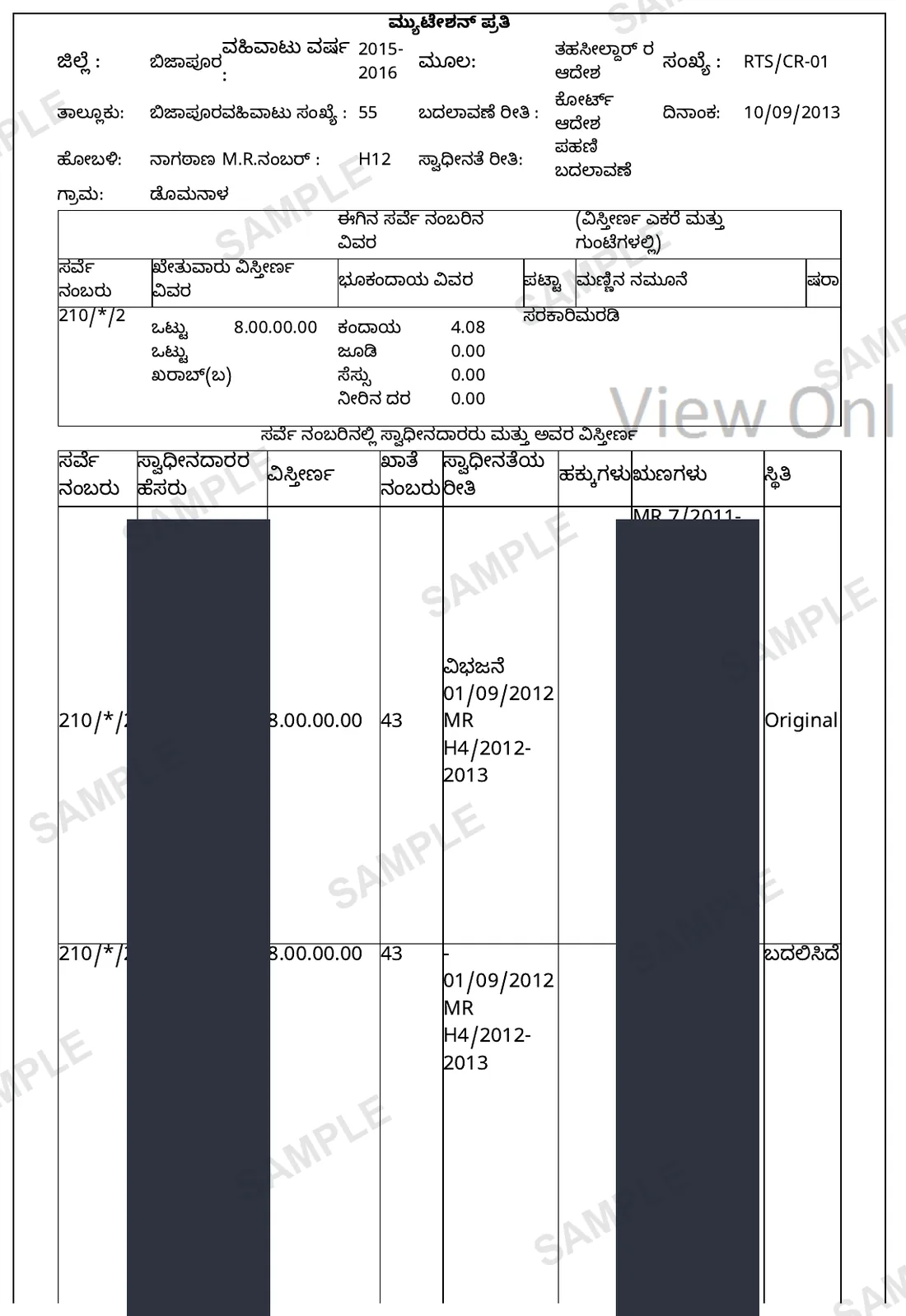
Traces every ownership change — sale, inheritance, partition, court order — from earliest records to today.
Your MR, in about 27 seconds.
Median of 6 delivered orders, straight from Bhoomi.
In Kannada: ಮ್ಯುಟೇಶನ್ ದಾಖಲೆ·Also known as: MR Karnataka · Bhoomi mutation · mutation extract · ಮ್ಯುಟೇಶನ್
How we know this: we retrieve the MR from Bhoomi for clients every working day, so the steps, failure modes and workarounds below are what the portal actually does — not a summary of its documentation.
Shubham Tiwadi is a partner at Anashwar Property Solutions in Vijayapura. His team operates the retrieval systems that pull Karnataka land records directly from the Bhoomi, Kaveri Online and e-Aasthi portals, and handles title verification for buyers across Vijayapura district.
What is the MR?
Maintained by the Tahsildar's office through Bhoomi, the Mutation Register records every ownership transfer of a land parcel from the earliest government records to the present.
Why you need this
A mutation may reveal disputed inheritance or an unapproved partition. For agricultural land, the MR often contains entries that pre-date the EC system and is essential for establishing a clear title chain.
What the MR contains
- Mutation number and date for each ownership change
- Previous and new owner details for every transfer
- Reason for mutation: sale, inheritance, court order, gift, partition
- Reference document numbers and court orders
- Remarks, disputes, or holds on any mutation entry
Step by step
How to get the MR online
- 1
Open the Bhoomi portal at landrecords.karnataka.gov.in and choose "View RTC and MR".
- 2
Select District, Taluk, Hobli and Village, then enter the Survey Number with its Surnoc and Hissa.
- 3
Switch to the MR tab to list every mutation recorded against that parcel.
- 4
Open each mutation entry in turn — the register is a chain, and a single entry read alone is misleading.
- 5
Reconcile the chain end to end: every transfer out should have a matching transfer in.
The official portal is Bhoomi landrecords.karnataka.gov.in (Revenue Department, Government of Karnataka). We fetch from it on your behalf — you never need to register there.
Anashwar Docs runs this sequence for you against the government portal and returns the PDF in 27 seconds. Fill the form above to get it now.
What goes wrong
Common MR mistakes
The MR is the only place inheritance and partition transfers appear. These never touch the Sub-Registrar, so the EC will not show them.
A mutation marked as disputed or held stays visible in the register. Read the remarks column on every entry, not just the latest.
Gaps in the chain matter more than the entries themselves. If ownership jumps from A to C with no A→B→C record, ask why.
Pre-digitisation entries were transcribed from handwritten registers. Extents and names carry transcription errors — cross-check extent against the RTC and the survey sketch.
Mutation is not automatic after registration. A registered sale deed with no corresponding mutation means the buyer never took revenue possession.
Fix errors fast
MR troubleshooting guide
| Symptom on Bhoomi | How to fix it |
|---|---|
| A mutation is marked disputed or held | Read the remarks column on every entry, not just the latest. A held mutation stays visible and the underlying dispute may be live. |
| Ownership jumps with no intermediate entry | A transfer was never recorded, or the parcel was renumbered at re-survey. Trace it at the Tahsildar office before proceeding. |
| Registered sale deed with no matching mutation | The buyer paid but never took revenue possession. One of the most reliable early indicators of a problem property. |
| Extents across entries do not sum | Partition rounding, or an unrecorded sub-division. Reconcile against the survey sketch and the Akarband. |
| Chain begins with a government grant | Grant conditions may restrict transfer. Obtain the grant order and check the non-alienation period before buying. |
| Handwritten pre-digitisation entries unreadable | Request a certified copy of the village register at the Tahsildar office. |
Frequently asked questions
What is a Mutation Register in Karnataka?
The Mutation Register records every change of ownership entered in the revenue records for a land parcel — by sale, inheritance, gift, partition or court order — with the mutation number, date, parties, and the reference document behind each change.
Why check the MR if I already have the EC?
They cover different things. The EC shows registered transactions at the Sub-Registrar from 2004. The MR shows revenue-record transfers including inheritance and partition, which are never registered and go back much further.
What does a gap in the mutation chain mean?
It means a transfer happened that was never recorded, or was recorded under a different survey number after a re-survey. Either way the title chain is incomplete and needs to be traced at the Tahsildar office before you buy.
50+ MR delivered across Karnataka
What customers say
"Excellent service. Found a plot on Solapur Road within a week. The consultant was very knowledgeable about the local market and helped negotiate a fair price. Highly recommend."
— Praveen Kulkarni
"Listed my house through Anashwar and got serious buyers within days. My contact number was never shared publicly — exactly what I wanted. Professional and trustworthy team."
— Shreya Patil
"Very transparent process. The consultant showed us properties matching our exact budget and requirements. No time-wasting. We bought a flat on Bangalore Road — very happy."
— Rajesh Desai
"I was nervous about listing my agricultural land but the team made it simple. Only 2% commission on sale, complete privacy, and sold within 3 weeks. Cannot ask for more."
— Anita Hiremath
Related
Documents you may also need
Bhoomi RTC — Pahani / Utara
Primary land ownership record from the Bhoomi portal — confirms who owns the land, land type, area, and tenancy.
ReadEC — Encumbrance Certificate
Shows every registered transaction on the property — loans, mortgages, and disputes since 2004.
ReadAI Title History Report
Give us the survey number — we pull the records ourselves and return a 20–30 page ownership chain, encumbrance analysis and risk report.
ReadGuides
How to read and use MR
Documents Banks Ask For on a Land or Plot Loan in Karnataka: The Complete List and Where Each Comes From
Bank legal departments reject land-loan files for missing documents far more often than for bad title. This is the list they work from, which portal issues each item, and the version they will accept.
How to Read a Karnataka RTC (Pahani): Every Column Explained with What to Check Before You Buy
Survey number, extent and the owner's name are the three things everyone reads on a Pahani. The other thirteen columns are where the problems are. A column-by-column reading, with the red flags.
Mutation in Karnataka: How to Apply, Track the Status and Get the MR Extract in 2026
A registered deed does not change the RTC. Mutation is the Revenue Department's process that does — here is how to start it, why it stalls at the Village Accountant, and how to pull the MR extract once it is through.
Akarband vs RTC Extent Mismatch: How to Fix Land Area Discrepancies in 2026
Discover the root causes of area discrepancies between the Akarband and RTC in Karnataka and understand the Section 133 rectification process to secure your land title.
Bhoomi Online Login & Services: i-Wallet, RTC, MR & Conversion Status in 2026
Learn how to navigate Bhoomi online login, top up your i-Wallet, and access services like RTC, MR extracts, and land conversion tracking in Karnataka.
NA Conversion Status Messages Explained: What Each Portal Status Means and What to Do Next
A comprehensive guide on checking your NA conversion status online in Karnataka, decoding portal messages, and downloading your NA final order securely.
Land records in Bangalore Urban district: navigating BBMP, SRO zones, and E-Khata in 2026
Finding property records in Bangalore Urban means navigating overlapping jurisdictions. Learn how to locate your BBMP Khata, identify your SRO zone, and pull Encumbrance Certificates from Kaveri Online.
Land records in Belgaum (Belagavi) district: taluks, border complexities and SROs
Belgaum presents unique challenges for land records: a district fractured into 16 taluks, a cross-border linguistic mix affecting legacy documents, and a city answering to both Belgaum and Belagavi.
Land records in Mysore district: MUDA, E-Aasthi, and Taluk boundaries
Navigating Mysore land records requires understanding a mix of state portals, MUDA allocations, and recent taluk reorganisations. Here is how to find and verify the documents you need.
Old EC Before 2004: How to Get Manual Encumbrance Certificate in Karnataka (2026)
Property records in Karnataka before April 2004 are not digitized on the Kaveri online portal. Learn the complete offline process to obtain a manual Encumbrance Certificate (EC) directly from the Sub-Registrar office.
Property Document Checklist for Agricultural Land in Karnataka (2026)
A complete buyer checklist for purchasing agricultural land in Karnataka. Understand every document you need before signing the deed.
RERA Karnataka: How to Verify Project Status in 2026
A complete step-by-step guide to checking builder credentials, project registration, and complaint history on the official RERA Karnataka portal.
RTC vs Pahani vs Utara: Understanding Karnataka's Crucial Land Record
Demystifying the terminology around Karnataka's primary agricultural land document, explaining regional differences, and clearing up the 7/12 Utara confusion.
Signed RTC vs Free RTC: Exploring i-Wallet Payments and QR Verification in 2026
A comprehensive guide to downloading legally valid signed RTCs using the i-Wallet system on the Bhoomi portal, compared to free informational RTCs.
Who can buy agricultural land in Karnataka, and what still restricts it
Karnataka opened agricultural land to non-farmers in 2020. Sellers now describe it as unrestricted. Four separate restrictions still apply and any one of them can void your purchase.
Bhoomi RTC shows "No Record Found" — 9 causes and how to fix each
The Bhoomi portal says your survey number does not exist. It almost always does. Here are the nine reasons the lookup fails and what to do about each one.
Dishaank: finding a Karnataka survey number from the map, not the paperwork
Every other land record starts with a survey number. Dishaank is the one that starts with a location — which makes it the tool you need when the number is exactly what you have lost.
Encumbrance Certificate in Karnataka: how to read one, not just download it
Everyone tells you to get an EC. Almost nobody tells you that a clean EC is not a clean title — and that the years it does not cover are exactly where the problems live.
Grant land and PTCL in Karnataka: the defect that survives every resale
Most title risks are visible in the Encumbrance Certificate. This one is not, it survives multiple honest resales, and a good-faith purchaser is not protected.
Gunta, acre and square feet: reading Karnataka land measurements
An RTC that reads "2-15" means two acres fifteen guntas, not two point one five. Getting that wrong changes the extent by a third and it happens constantly.
Land records in Vijayapura district: taluks, SROs and the Bijapur name problem
Vijayapura throws two problems no state-level guide covers: a taluk reorganisation the portals lag behind, and a city that answers to two names across forty years of documents.
Mojini, Tippan and Akarband: how to get a Karnataka survey sketch
Boundary disputes are the most common property litigation in Karnataka. The survey sketch is the document that settles them — and almost nobody explains which of the four records to ask for.
Anashwar Docs
Get your MR now.
Enter the details below. We fetch it from Bhoomi and return the official PDF in 27 seconds.