Encumbrance Certificate (EC) in Karnataka (ಋಣಭಾರ ಪ್ರಮಾಣಪತ್ರ)
Transaction & Liability History
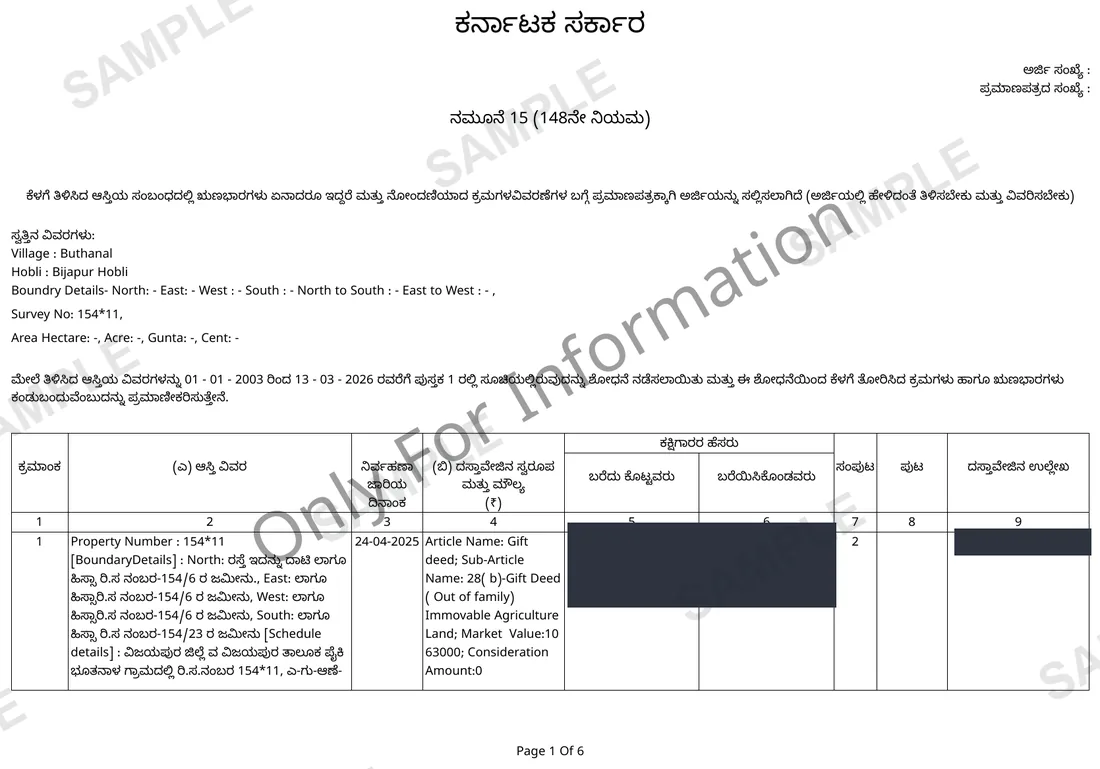
Shows every registered transaction on the property — loans, mortgages, and disputes since 2004.
Your EC, in about 38 seconds.
Median of 63 delivered orders, straight from Kaveri Online.
In Kannada: ಋಣಭಾರ ಪ್ರಮಾಣಪತ್ರ·Also known as: EC Karnataka · Kaveri EC · Encumbrance Certificate online · Bhoomi Encumbrance Report · RTC EC
How we know this: we retrieve the EC from Kaveri Online for clients every working day, so the steps, failure modes and workarounds below are what the portal actually does — not a summary of its documentation.
Shubham Tiwadi is a partner at Anashwar Property Solutions in Vijayapura. His team operates the retrieval systems that pull Karnataka land records directly from the Bhoomi, Kaveri Online and e-Aasthi portals, and handles title verification for buyers across Vijayapura district.
What is the EC?
Issued by the Sub-Registrar's office and available digitally through Kaveri Online Services, the EC records every registered transaction on a property since 2004.
Why you need this
Never purchase property without a clean EC for the past 15–30 years. If a property has an unpaid loan, that loan appears here. It is the single most critical document for a buyer.
What the EC contains
- All registered sale deeds, mortgage deeds, and gift deeds
- Release deeds and partition deeds
- Outstanding mortgages and loans registered against the property
- Names of all parties in each transaction
- Document numbers and registration dates for every transaction
Step by step
How to get the EC online
- 1
Open Kaveri Online Services at kaverionline.karnataka.gov.in and register or log in as a citizen user.
- 2
From the services menu choose Encumbrance Certificate, then EC Search.
- 3
Enter the district, taluk, village or SRO, and the survey number or property identifier.
- 4
Set the search period. For a purchase, search at least the last 15 years; 30 years is safer.
- 5
View the free information copy after OTP verification, or tick the digitally signed option and pay the fee for a legally valid certificate.
The official portal is Kaveri Online Services kaveri.karnataka.gov.in (Department of Stamps and Registration). We fetch from it on your behalf — you never need to register there.
Anashwar Docs runs this sequence for you against the government portal and returns the PDF in 38 seconds. Fill the form above to get it now.
What goes wrong
Common EC mistakes
Online records generally begin at April 2004. Anything older needs a manual search at the Sub-Registrar office — and pre-2004 is exactly where most title defects hide.
A Nil EC (Form 16) does not mean the property is clean. It means nothing was registered in that window at that SRO. Widen the period and check adjacent SROs.
The EC lists only registered transactions. Unregistered agreements to sell, oral partitions, court attachments and tax dues do not appear.
Property descriptions vary between deeds. If the survey number was renumbered after a re-survey, a search on the current number can silently miss earlier entries.
The free information copy is watermarked and not accepted by banks. Only the digitally signed copy is.
Fix errors fast
EC troubleshooting guide
| Symptom on Kaveri Online | How to fix it |
|---|---|
| Nil EC returned (Form 16) | Not a clean chit. Widen the search period and confirm you searched the correct Sub-Registrar office for the property location. |
| Nothing before 2004 | Expected — Kaveri holds digitised records from around April 2004. Earlier periods need a manual register search at the SRO. |
| Property description does not match | The survey number may have been renumbered at re-survey, or you searched an adjoining parcel. Verify the identifier against the current RTC. |
| Mortgage shows with no release | The charge is very likely still live. Ask for the registered release deed and find it yourself on the EC before completing. |
| Free copy rejected by the bank | The information copy is watermarked and not legally valid. Apply for the digitally signed certified copy and allow processing days. |
| Chain jumps from one owner to another | A transfer was never registered, or it happened by inheritance or partition. Read the Mutation Register alongside. |
Frequently asked questions
What does the Encumbrance Certificate actually show?
The EC lists every registered transaction on a property — sale deeds, mortgage deeds, gift deeds and release deeds. If there is an unpaid bank loan registered against the property, it appears here.
What is the difference between Form 15 and Form 16?
Form 15 is issued when registered transactions exist in the period searched. Form 16, a "Nil EC", is issued when no registered transactions were found. A Nil EC is not a clean chit — it only covers the period and office you searched.
How many years of EC should I check before buying?
At minimum 15 years. For any significant purchase, 30 years is the standard due-diligence window because it covers the limitation period for most adverse claims.
Can I get an EC for the period before 2004?
Not through the online portal. Kaveri holds digitised records from roughly April 2004. Earlier periods require a manual search of the register at the relevant Sub-Registrar office.
Is the RTC the same as the Encumbrance Certificate (EC)?
No — they are different documents from different portals. The RTC (Pahani) comes from Bhoomi and records who holds the land, its extent and its crops. The EC comes from Kaveri Online Services and records every registered transaction on the property — sales, mortgages, gifts and releases. A buyer needs both: the RTC says who holds it, the EC says whether it is pledged or was transferred.
Is the Encumbrance Certificate available on the Bhoomi portal?
No. Bhoomi holds revenue records — the RTC and the Mutation Register. The Encumbrance Certificate is a registration record and is issued only through Kaveri Online Services by the Department of Stamps and Registration. Searching Bhoomi for an "encumbrance report" returns nothing because the document does not live there.
60+ EC delivered across Karnataka
What customers say
"Excellent service. Found a plot on Solapur Road within a week. The consultant was very knowledgeable about the local market and helped negotiate a fair price. Highly recommend."
— Praveen Kulkarni
"Listed my house through Anashwar and got serious buyers within days. My contact number was never shared publicly — exactly what I wanted. Professional and trustworthy team."
— Shreya Patil
"Very transparent process. The consultant showed us properties matching our exact budget and requirements. No time-wasting. We bought a flat on Bangalore Road — very happy."
— Rajesh Desai
"I was nervous about listing my agricultural land but the team made it simple. Only 2% commission on sale, complete privacy, and sold within 3 weeks. Cannot ask for more."
— Anita Hiremath
Related
Documents you may also need
Bhoomi RTC — Pahani / Utara
Primary land ownership record from the Bhoomi portal — confirms who owns the land, land type, area, and tenancy.
ReadMutation Register (MR)
Traces every ownership change — sale, inheritance, partition, court order — from earliest records to today.
ReadAI Title History Report
Give us the survey number — we pull the records ourselves and return a 20–30 page ownership chain, encumbrance analysis and risk report.
ReadGuides
How to read and use EC
B-Khata to A-Khata Conversion in Karnataka: Who Qualifies, What It Costs, How to Apply in 2026
A B-khata is a tax entry, not a title. Turning it into an A-khata means fixing whatever kept it out of the A register — usually conversion, layout approval or betterment charges — and then applying. Here is the whole path.
Documents Banks Ask For on a Land or Plot Loan in Karnataka: The Complete List and Where Each Comes From
Bank legal departments reject land-loan files for missing documents far more often than for bad title. This is the list they work from, which portal issues each item, and the version they will accept.
How to Read a Karnataka RTC (Pahani): Every Column Explained with What to Check Before You Buy
Survey number, extent and the owner's name are the three things everyone reads on a Pahani. The other thirteen columns are where the problems are. A column-by-column reading, with the red flags.
Khata Transfer in Karnataka: Process, Documents and Fees in 2026
A registered sale deed does not put your name on the khata. The transfer is a separate application at the local body — here is the process for BBMP, other ULBs and gram panchayats, with the documents and the usual delays.
Power of Attorney for Property in Karnataka: GPA vs SPA, Registration, and Why a "GPA Sale" Is Not a Sale
A GPA lets someone act for the owner; it does not make them the owner. What each kind of PoA can do, when it must be registered and stamped, and the checks a buyer must run when the person across the table holds one.
Stamp Duty and Registration Charges in Karnataka: Rates, Surcharge and a Worked Example for 2026
The number agents quote is never the number the SRO collects. Here is how the duty, surcharge, cess and registration fee stack up in Karnataka, what they are charged on, and where to pay.
Which Karnataka Portal Holds My Property Record? Bhoomi vs e-Swathu vs e-Aasthi vs Kaveri
Searching the wrong portal returns "no record found" for a perfectly real property. Which of Bhoomi, e-Swathu, e-Aasthi, BBMP e-Aasthi and Kaveri holds your record depends on one question — who taxes it.
Kaveri Guideline Value 2026: How to Check & Stamp Duty Arithmetic
A complete guide to checking property guideline values on Kaveri Online Services, calculating stamp duty, and understanding how notified hedge rates affect your real estate transactions in Karnataka.
e-Swathu Form 9 vs Form 11B: Guide to Gram Panchayat Property Forms in 2026
Understand the critical differences between Form 9 (A-Khata) and Form 11B (B-Khata) for Gram Panchayat properties in Karnataka under the e-Swathu system.
Free View vs Digitally Signed EC in Karnataka: What Banks & SROs Accept
Confused between the free view and digitally signed Encumbrance Certificate? Discover their legal differences and when you absolutely need a certified copy for loans or registration.
How to Get Your Encumbrance Certificate Online in Bangalore (Kaveri 2.0 & SRO Guide): Benefit in 2026
A complete 2026 guide to obtaining an Encumbrance Certificate (EC) online in Bangalore, including a breakdown of Kaveri 2.0 and Bengaluru SRO area mapping.
How to Find Your SRO (Sub-Registrar Office) in Karnataka: Complete Guide 2026
Locating your exact Sub-Registrar Office (SRO) jurisdiction in Karnataka is a crucial first step for registering property, obtaining an Encumbrance Certificate, or registering a marriage.
How to Get a Certified Copy of a Sale Deed in Karnataka (2026)
Lost your original property documents? Learn how to easily obtain a certified copy of your sale deed online in Karnataka through the Kaveri 2.0 portal with our step-by-step guide.
Land records in Bangalore Urban district: navigating BBMP, SRO zones, and E-Khata in 2026
Finding property records in Bangalore Urban means navigating overlapping jurisdictions. Learn how to locate your BBMP Khata, identify your SRO zone, and pull Encumbrance Certificates from Kaveri Online.
Land records in Belgaum (Belagavi) district: taluks, border complexities and SROs
Belgaum presents unique challenges for land records: a district fractured into 16 taluks, a cross-border linguistic mix affecting legacy documents, and a city answering to both Belgaum and Belagavi.
Land records in Mysore district: MUDA, E-Aasthi, and Taluk boundaries
Navigating Mysore land records requires understanding a mix of state portals, MUDA allocations, and recent taluk reorganisations. Here is how to find and verify the documents you need.
Old EC Before 2004: How to Get Manual Encumbrance Certificate in Karnataka (2026)
Property records in Karnataka before April 2004 are not digitized on the Kaveri online portal. Learn the complete offline process to obtain a manual Encumbrance Certificate (EC) directly from the Sub-Registrar office.
Property Document Checklist for Agricultural Land in Karnataka (2026)
A complete buyer checklist for purchasing agricultural land in Karnataka. Understand every document you need before signing the deed.
RERA Karnataka: How to Verify Project Status in 2026
A complete step-by-step guide to checking builder credentials, project registration, and complaint history on the official RERA Karnataka portal.
A-Khata vs B-Khata: what the difference actually costs a buyer
B-Khata property is cheaper for a reason. The discount is the market pricing in a financing problem, a construction problem and an exit problem that the seller is hoping you will not price.
E-Khata in Karnataka: from E-Aasthi record to signed certificate
The E-Khata is mandatory for registration, home loans and plan approval. Most rejections have nothing to do with the application — they are problems in the underlying E-Aasthi record.
Encumbrance Certificate in Karnataka: how to read one, not just download it
Everyone tells you to get an EC. Almost nobody tells you that a clean EC is not a clean title — and that the years it does not cover are exactly where the problems live.
Grant land and PTCL in Karnataka: the defect that survives every resale
Most title risks are visible in the Encumbrance Certificate. This one is not, it survives multiple honest resales, and a good-faith purchaser is not protected.
Land records in Vijayapura district: taluks, SROs and the Bijapur name problem
Vijayapura throws two problems no state-level guide covers: a taluk reorganisation the portals lag behind, and a city that answers to two names across forty years of documents.
Vijayapura plot prices by zone: what 113 live listings actually ask
Published rate tables for Vijayapura are guesswork. This one is computed from our own live listing book — 113 plots quoted per square foot across 11 zones, with the sample size shown for each.
Anashwar Docs
Get your EC now.
Enter the details below. We fetch it from Kaveri Online and return the official PDF in 38 seconds.