AI Title History Report for Karnataka Property (ಮಾಲೀಕತ್ವ ಇತಿಹಾಸ ವರದಿ)
AI Ownership Chain & Risk Analysis
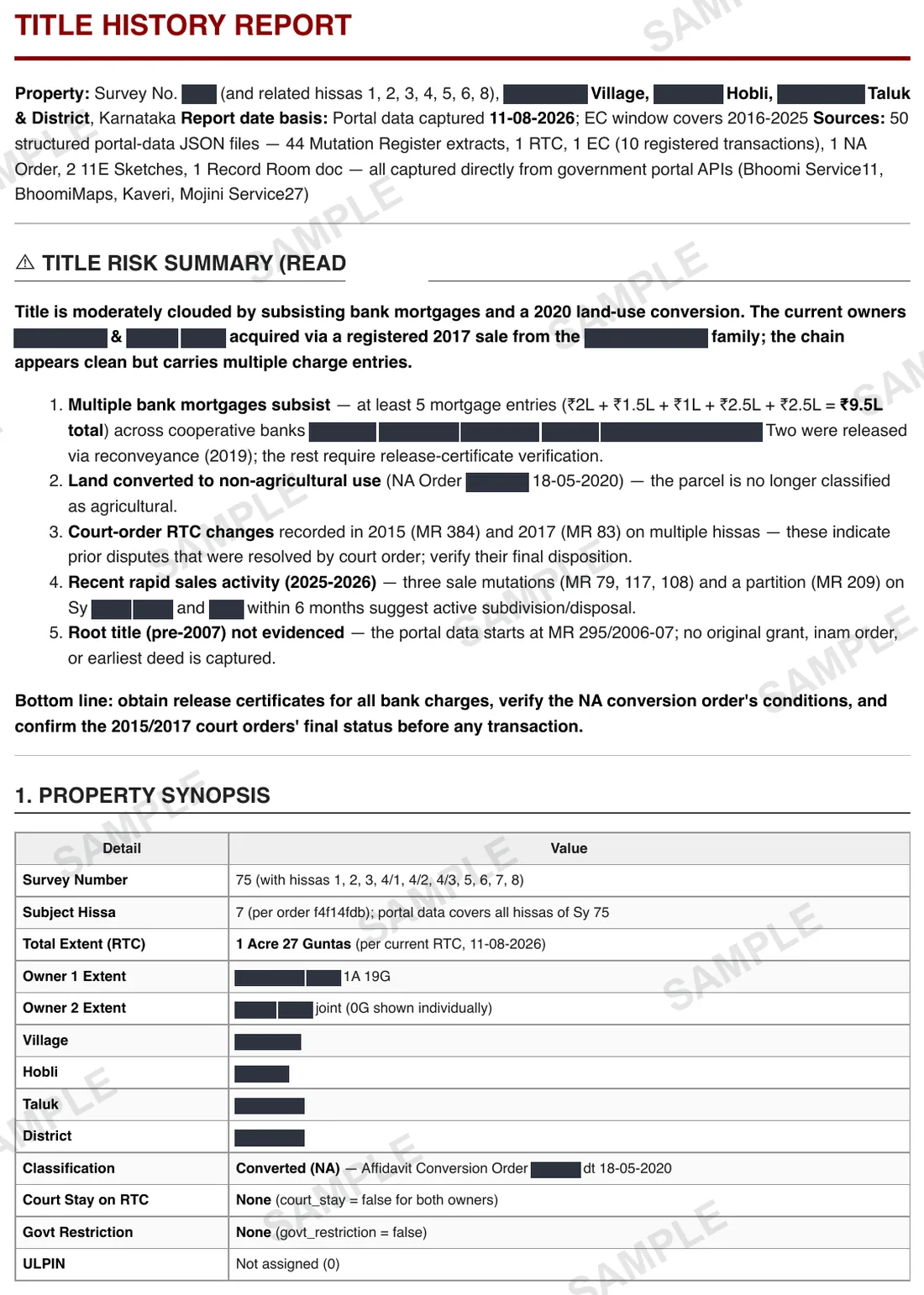
Give us the survey number — we pull the records ourselves and return a 20–30 page ownership chain, encumbrance analysis and risk report.
Your Title Report, in about 24–48 hrs.
Retrieved from Anashwar AI the moment you order.
In Kannada: ಮಾಲೀಕತ್ವ ಇತಿಹಾಸ ವರದಿ·Also known as: title search report · property due diligence Karnataka · title verification · land title check
How we know this: we retrieve the Title Report from Anashwar AI for clients every working day, so the steps, failure modes and workarounds below are what the portal actually does — not a summary of its documentation.
Shubham Tiwadi is a partner at Anashwar Property Solutions in Vijayapura. His team operates the retrieval systems that pull Karnataka land records directly from the Bhoomi, Kaveri Online and e-Aasthi portals, and handles title verification for buyers across Vijayapura district.
What is the Title Report?
You give us the parcel, not a pile of files. We fetch the RTC, the Encumbrance Certificate, the Mutation Register and the survey records for that survey number from the government portals, then a two-stage AI pipeline reads them together and produces a Title History Report.
Why you need this
A lawyer's title opinion costs ₹5,000–₹20,000 and takes weeks. The AI report highlights exactly where to probe — identifying risk flags, title chain gaps, and document discrepancies.
What the Title Report contains
- Complete ownership chain from earliest records to present
- Encumbrance analysis — all loans and their status
- Risk flags: disputed mutations, title gaps, NA violations
- Document cross-verification for discrepancies between EC and MR
- Plain-English summary for non-legal readers (20–30 pages)
Step by step
How to get the Title Report online
- 1
Enter the parcel — district, taluk, hobli, village and survey number with its surnoc and hissa.
- 2
We retrieve the source records for that parcel: the RTC, the Encumbrance Certificate, the Mutation Register and the survey documents.
- 3
The pipeline extracts every transaction, reconstructs the ownership chain, and reconciles extents across records.
- 4
Where a record exists only on paper at the taluk office, the report says so rather than leaving a silent gap.
- 5
The report lands in your account within 24–48 hours — ownership chain, encumbrance analysis, discrepancy catalogue and risk flags in plain English.
Anashwar Docs runs this sequence for you against the government portal and returns the PDF in 24–48 hrs. Fill the form above to get it now.
What goes wrong
Common Title Report mistakes
The report is a due-diligence aid, not a legal opinion. It tells you where to probe; it does not certify title.
Output quality tracks record quality. Where Kaveri holds only post-2004 entries, the chain starts there, and the defect you are looking for is often older.
Scanned handwritten mutation entries extract less reliably than digital records. Flagged low-confidence entries need manual reading.
A clean report on a thin record set is the most dangerous outcome. Read what the report says it could not find.
Fix errors fast
Title Report troubleshooting guide
| Symptom on Anashwar AI | How to fix it |
|---|---|
| Report came back clean but you are uneasy | Check the record coverage the report states. Where Kaveri holds only post-2004 entries the chain starts there, and the defect you are looking for is usually older. |
| Entries flagged low confidence | Scanned handwritten mutation entries extract less reliably. Those specific entries need manual reading. |
| Chain has a gap | A transfer was never recorded or the parcel was renumbered. Trace it at the Tahsildar office — the report tells you where to look, not what happened. |
| EC and Mutation Register disagree on the owner | One of the two systems was never updated. Establish which before you rely on either. |
| Report is not accepted as a legal opinion | It is not one. It is a due-diligence aid. Take it to an advocate — it makes their work faster and cheaper. |
Frequently asked questions
What documents do I need before buying property in Karnataka?
At minimum: the RTC, an Encumbrance Certificate covering 15–30 years, and the Mutation Register. For agricultural land add the NA Order and PT Sheet. For urban property add the E-Aasthi record and E-Khata.
Does the AI report replace a lawyer?
No. It is a due-diligence aid that reconstructs the ownership chain and surfaces discrepancies and risk flags fast and cheaply. For a binding title opinion on a significant purchase, take the report to an advocate — it makes their job faster and their fee lower.
How long does the report take?
Within 24 to 48 hours, compared with one to three weeks for a traditional title opinion. We retrieve the source records ourselves, so the clock starts when you give us the parcel, not when you finish collecting documents.
What is an AI Title History Report?
A structured report that reads the RTC, Mutation Register, Encumbrance Certificate and survey records for one parcel, reconstructs the ownership chain entry by entry, flags gaps, encumbrances and extent mismatches, and lists the questions to put to the seller before paying. It is generated from the actual government records, not from the seller's summary.
Which properties can the report cover?
Any Karnataka parcel with a survey number in Bhoomi and an SRO record in Kaveri — agricultural land, converted sites and urban property with an e-Aasthi entry. Where a record exists only on paper at the taluk office, the report states that gap rather than guessing past it.
760+ documents delivered across Karnataka
What customers say
"Excellent service. Found a plot on Solapur Road within a week. The consultant was very knowledgeable about the local market and helped negotiate a fair price. Highly recommend."
— Praveen Kulkarni
"Listed my house through Anashwar and got serious buyers within days. My contact number was never shared publicly — exactly what I wanted. Professional and trustworthy team."
— Shreya Patil
"Very transparent process. The consultant showed us properties matching our exact budget and requirements. No time-wasting. We bought a flat on Bangalore Road — very happy."
— Rajesh Desai
"I was nervous about listing my agricultural land but the team made it simple. Only 2% commission on sale, complete privacy, and sold within 3 weeks. Cannot ask for more."
— Anita Hiremath
Related
Documents you may also need
EC — Encumbrance Certificate
Shows every registered transaction on the property — loans, mortgages, and disputes since 2004.
ReadMutation Register (MR)
Traces every ownership change — sale, inheritance, partition, court order — from earliest records to today.
ReadBhoomi RTC — Pahani / Utara
Primary land ownership record from the Bhoomi portal — confirms who owns the land, land type, area, and tenancy.
ReadGuides
How to read and use Title Report
Mutation in Karnataka: How to Apply, Track the Status and Get the MR Extract in 2026
A registered deed does not change the RTC. Mutation is the Revenue Department's process that does — here is how to start it, why it stalls at the Village Accountant, and how to pull the MR extract once it is through.
Power of Attorney for Property in Karnataka: GPA vs SPA, Registration, and Why a "GPA Sale" Is Not a Sale
A GPA lets someone act for the owner; it does not make them the owner. What each kind of PoA can do, when it must be registered and stamped, and the checks a buyer must run when the person across the table holds one.
How to Get Your Encumbrance Certificate Online in Bangalore (Kaveri 2.0 & SRO Guide): Benefit in 2026
A complete 2026 guide to obtaining an Encumbrance Certificate (EC) online in Bangalore, including a breakdown of Kaveri 2.0 and Bengaluru SRO area mapping.
Encumbrance Certificate in Karnataka: how to read one, not just download it
Everyone tells you to get an EC. Almost nobody tells you that a clean EC is not a clean title — and that the years it does not cover are exactly where the problems live.
Grant land and PTCL in Karnataka: the defect that survives every resale
Most title risks are visible in the Encumbrance Certificate. This one is not, it survives multiple honest resales, and a good-faith purchaser is not protected.
Anashwar Docs
Get your Title Report now.
Enter the details below. We fetch it from Anashwar AI and return the official PDF in 24–48 hrs.